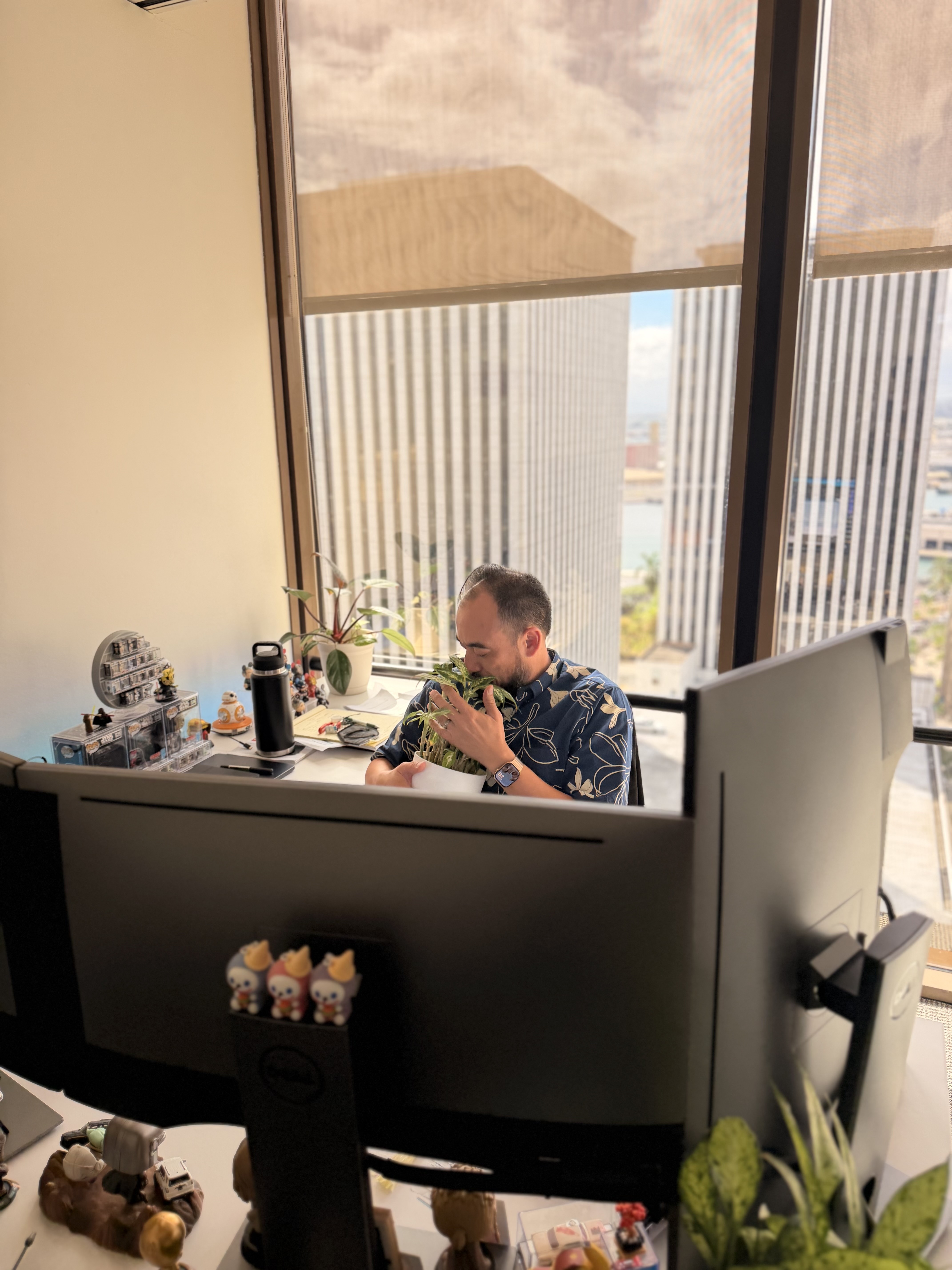
The plants in Eric Newhouse's office did not arrive on purpose.
Nobody bought them for him. Nobody assigned them to him. They are not part of a wellness initiative. They are not, as far as Eric is concerned, a hobby. The plants just — at some point, one by one — showed up. And Eric, being Eric, did not say no.
He doesn't know their names. He couldn't tell you which is a Dracaena and which is a Philodendron if his Slack streak depended on it. He knows when they need water. He knows when one of them is leaning toward the window and could use a quarter-turn. He knows the one on the corner of the desk gets crispy when the building's AC runs hard. That's enough. That's, in fact, the entire job.
The plants are alive because Eric is there.
House is short for Newhouse
There was a brief period when we had two Erics on staff. There was never any debate about who got to be Eric. The other Eric got to be Eric, and Newhouse was always going to be House. Three years in, almost nobody on the team thinks of him by his given name anymore. He's just House. The nickname stuck for the same reason most good nicknames stick — it was already true before anybody said it out loud.
What you should know about House, in roughly the order that surprises people:
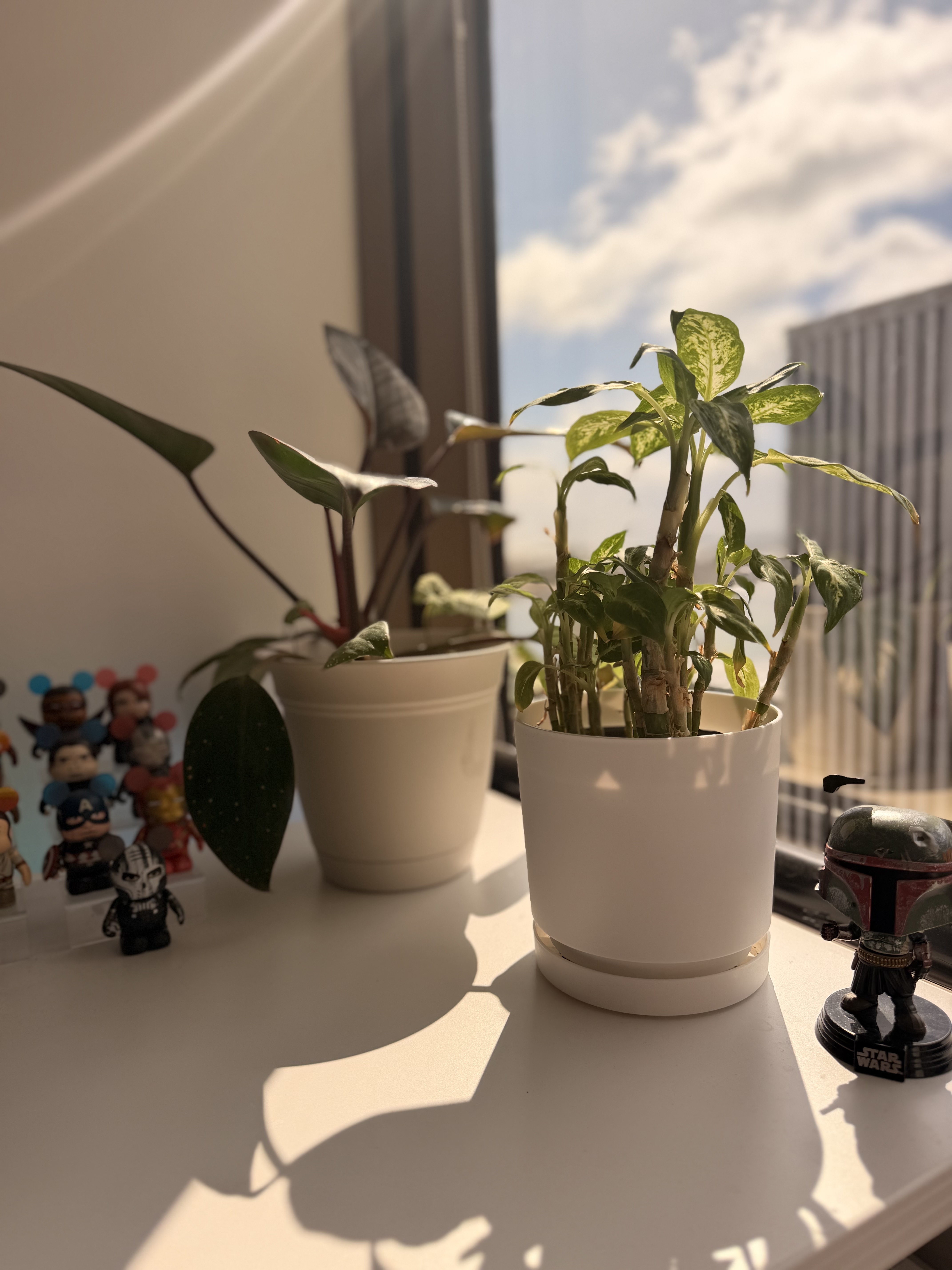
He's from Kauai. (Hawaii readers: that explains a lot.) (Mainland readers: Kauai is the garden isle, the lushest and most laid-back of the Hawaiian islands. Of course Eric is from there. Of course he is.) He started his career in graphic design and photography, not IT. He worked in-house at a well-known local company doing visual design before pivoting into technology, which is why his desk has the composed visual language of someone who has thought about what goes where. The Vinylmations are not piled. They are in formation, on acrylic risers, against a black Death Star backdrop. The plants are in matching white ceramic pots. Boba Fett stands guard at the corner of the windowsill. The corner is composed.
He's quiet, but the quiet is a tell. He's thinking. The thoughts come out fully formed, often via a pun in Slack that lands so cleanly you fall off your chair laughing. The first time it happens to a new hire, they nearly miss it, because they've already filed him under straight-laced. He's not straight-laced. He's just deciding whether the thing he wants to say is worth saying yet.
He has two little girls under seven. He goes home to them at the end of the day.
He used to share a cubicle wing with three other techs and was interrupted approximately every fourteen minutes. We gave him his own office. The interruption rate has since gone up — the guys who used to interrupt him from the next cubicle over now just stand up, walk down the hall, and interrupt him in the office. He has not, as far as I can tell, complained about this once.
The version of him you don't see at the desk
A friend of mine named ZB had been working with our team in a contracting capacity for over a year before he came into town and joined the guys for happy hour. He'd been on Teams with House for what must have been close to a hundred hours by then, and he'd been in our office, in person, alongside House, on multiple occasions. He knew House. Or at least he thought he did.
Three drinks into happy hour, ZB turned to me with the expression of a man who'd just witnessed a magic trick, and said some version of: this guy is just a really cool dude.
This is the House problem. The version of him you see at his battle station, gathering his thoughts before he speaks, considering the situation with the seriousness it warrants — that's one register. The version of him outside the office, in his element, off the clock — that's a different register entirely. Both are him. Most of his work life happens in the first register because that's where the work is. But it's worth knowing the second one exists.
A Tuesday Person at the battle station
There's a category of person at every company that you only really notice during a crisis. Most people, when something is on fire, get faster, louder, more visibly busy. They want you to see them working. They want it understood, in real time, that they are taking the situation seriously.
House does not do this.
When something is on fire at Indevtech — a client outage, a vendor going sideways, a Friday afternoon that has decided to become a Friday night — House sits at his battle station. He does not get up. He does not get louder. He does not get faster. He gets steadier. The pace is the same pace as Tuesday morning at 10 a.m. The mood is the same mood. The decisions get made one at a time, in the order they need to be made, and by the end of whatever-it-is, the thing is solved and House is still in the same chair.
This is a specific kind of person, and we have a name for it around here. House is a Tuesday Person. He is, in fact, possibly the Tuesday-iest person in the building. The steadiness is not a performance and not a workaround for anxiety — it's just how he is. The crisis adjusts itself to House. House does not adjust himself to the crisis.
You can teach a lot of things. You cannot, in my experience, teach this. You can hire for it. You can build a culture that doesn't drive it out of the people who have it. But you can't train somebody into being a Tuesday Person at the battle station. They come pre-installed.
Who he mentors
When somebody on the team has a problem and they don't know who to ask, they ask House. This is not by design. This is not in his job description. It happens because House, in addition to being Indevtech's Centralized Services Manager, is also the most natural reference person in the building.
He does not give answers. He asks the question that reframes the problem you've been struggling with for an hour. Then he goes back to his screen and lets you go figure it out, and you walk back to your desk knowing what to do.
If you've ever had a coworker like this, you know what I mean. If you haven't, I'm sorry. They're rare. Most of the workplace mythology of "10x engineers" is wrong, but the part that's right is this: there are people whose presence in the building makes everyone else around them better at their jobs. House is one of them. The plants are not the only thing he's quietly growing.
Why this corner of the office matters
I want to land somewhere honest about why I wrote this piece.
A workplace ends up with its character in two ways. The first way is on purpose — strategy, hiring, culture initiatives, the things that get presented at all-hands meetings and put in employee handbooks. Most of what people say about company culture is in this first category.
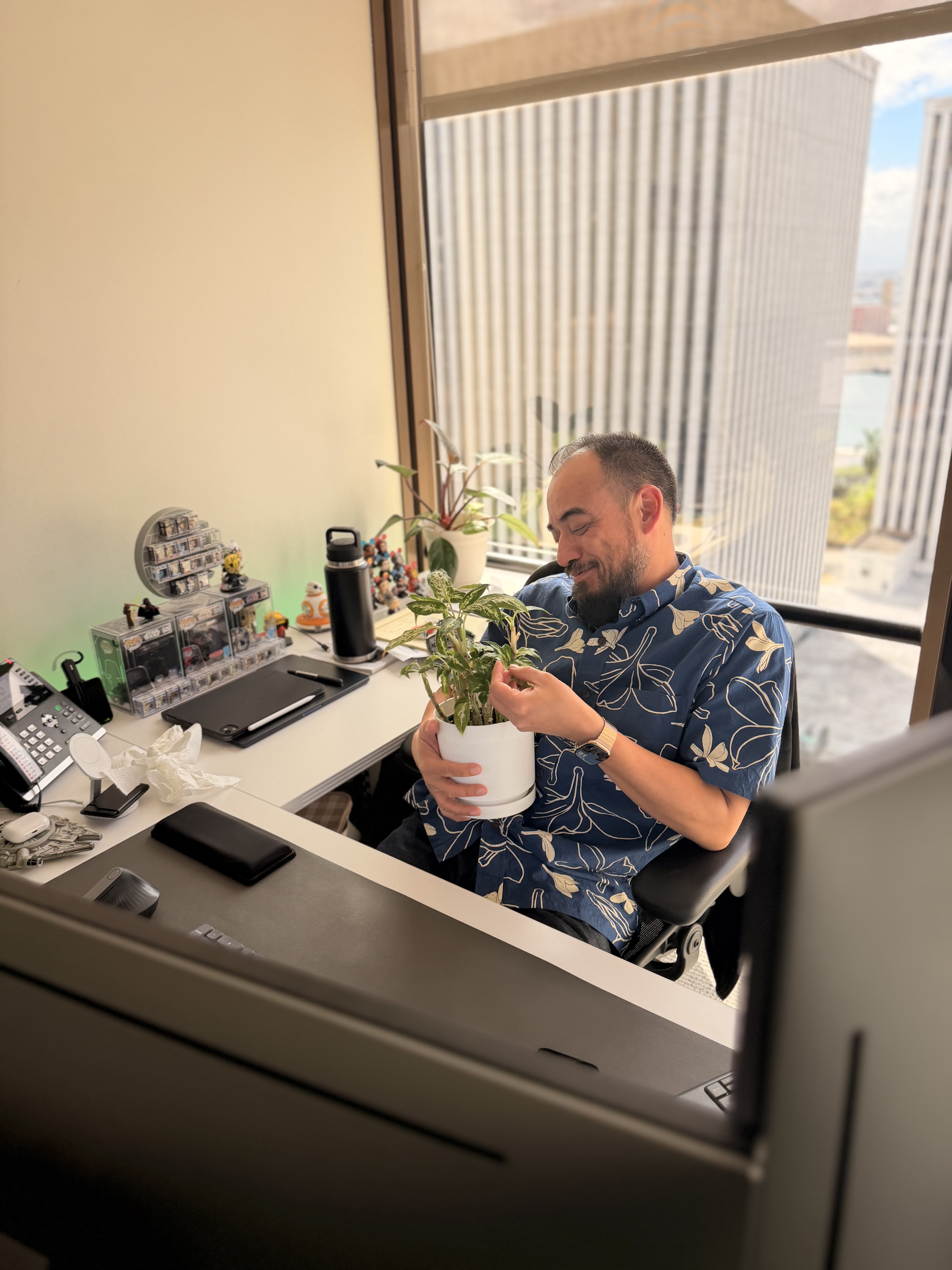
The second way is by accident. Somebody from Kauai shows up to work three years ago in an aloha shirt, doesn't say much for the first month, gradually reveals himself to be the team's quietest center of gravity, gets too many interruptions in the cubicle wing, gets his own office, and at some point the plants start arriving. Nobody planned the plants. The plants planned themselves. They arrived because the corner was ready for them.
The second way is the way that matters. It's also the way that's hardest to talk about, because the moment you try to engineer it — the moment you say "we should have more plants" or "we should hire more Houses" — you've already lost the thing that made it work in the first place.
You can't manufacture it. You can only get out of the way and let it happen.
Eric Newhouse showed up three years ago, and the office has been quietly greener ever since. Not the plants. The office. Everything about it.
That's the piece. Go say hi to House.